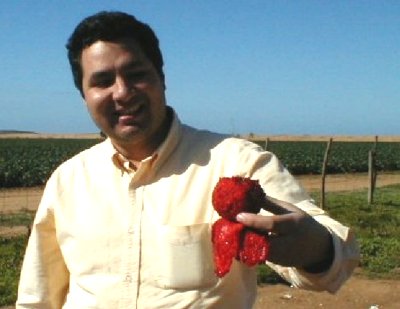
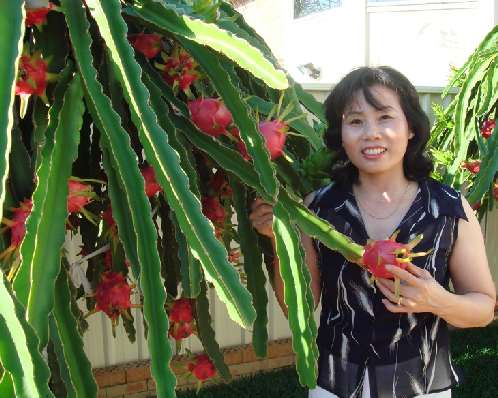
The photos of the outer skin in the link for "Dragon fruit" are not the same as the Pitahaya here in the Baja, but the inside fruit looks exactly the
same.
The way to find out if your fruit is ripe is that when you use a small knife to scrape off the needles, they should just drop away very easily. If the
fruit has broken open, it is still good to eat - just wash it good first
To get them off of the cactus, the locals use a long stick with a very sharp point on the end of it which they thrust up and into the fruit to get it
off the plant. It releases very easily.
This fruit does not have a very long shelf life. As well as eating "raw" - the best way in my opinion - you can make jelly out of it by boiling it
very slowly, adding sugar and then putting it through a cheesecloth to remove the seeds. You would do it the same as a fruit like grapes to make the
jelly. It is AWESOME in this way as well.
Enjoy your fruit!
Pitaya dulce (Organ Pipe Cactus)
David K - 10-5-2008 at 08:45 AM
Not the same as 'Dragonfruit'....
Antonio ('BajaCactus') and I stopped at a stand along Mex. 1 in San Quintin in November, 2004 and enjoyed the superior fruit of the Baja desert! Here
are some photos from my web page http://vivabaja.com/1104 when Antonio and I drove to El Rosario together.
On the right is the fruit with spines, on the left they were trimmed and ready to eat.
The fruit was brought up from La Paz.
Antonio shows me how to peel the fruit... it's easy!
Very juicy, 100% edible, tiny strawberry-like seeds, like biting into a cherry popcycle!Russ - 10-5-2008 at 09:54 AM
Great pics David. My friend gave me one last night and it's on my breakfast menu so I thought I'd take a few photos too. Divid's pics show them with
and without their spines. I'll use long BBQ tongs to pick them but if I can take the spines off first you can just grab'm. I eat them as David show
normally but they're really good cold. bajajudy - 10-5-2008 at 10:07 AM
The inside of the fruit looks just like Dragon Fruit. Dragon fruit grows on a plant that looks like a pineapple and they can be huge. When we were
in Nicaragua, the juice was available everywhere. I could not tell any difference in the flavor between the two fruits. Dragon fruits are definitely
easier to eat.
Shari is famous for her margaritas....Shari, we need that recipe!dtbushpilot - 10-5-2008 at 10:11 AM
They make fantastic margaritas.....dtshari - 10-5-2008 at 12:22 PM
here are the pithayas Juan got this morning out by san roque....yummmy just sliced up ...better cooled
OK so the world famous Pithaya Margarita...uh uh..nothin doin...it's kinda like a secret surf spot....ya gotta come and visit us to find out about it
(IF we like you!!!)jejejeje....
makes terrific slushies with rum too!
[Edited on 10-5-2008 by shari]
Russ - 10-5-2008 at 02:01 PM
Pithayas & a touch of the Captain Morgan blended yum!comitan - 10-5-2008 at 02:13 PM
First Pass or second. Pescador - 10-5-2008 at 02:26 PM
There are two Pithaya plants in Baja. Pithaya Agria (which is the one pictured) and Pithaya Dulce which is usually harvested in August. An old man
taught me how to pick them with an aluminum can that had the top cut off and was slitted to allow it to work like a crude pair of pliers and he put
the fruit in the can, held it, and then gently twisted and they came right off. The indians used something that looked a little like a claw with a
basket on a long stick and they would use basically the same movement. With a heavy pair of gloves you can easily brush the thorn nodules off and
then I usually cut them in half and use a spoon to dig out the fruit.
Comitan is referring to the practice of the indians who did what is called second harvest and they would gorge themselves on the fruit during season
but always put the defecation in a collective area so that when things got real tough later on in the winter, they would come back, break out the
seeds, roast them, and eat them when there was not much else available. I just finished a captivating book on the Seri indians of the mainland and
they basically did exactly the same thing. Great desert survival skill.Baja-Brit - 10-5-2008 at 02:41 PM
Quote:
Originally posted by David K
Not the same as 'Dragonfruit'....
Thanks for putting me straight David.
I was close right .....but no cigar.
As you were.David K - 10-5-2008 at 09:01 PM
Quote:
Originally posted by Baja-Brit
Quote:
Originally posted by David K
Not the same as 'Dragonfruit'....
Thanks for putting me straight David.
I was close right .....but no cigar.
As you were.
Yes, close... same 'type' of fruit as for how to eat and texture, etc. But, not the 'pitaya dulce' or 'pitaya agria' that grows in Baja... a
different, albeit similar fruit!Bob and Susan - 10-6-2008 at 05:49 AM
this is the second sunday afternoon i've had
to check a car out waaaayyy back in the "forest"...
both were "older" mexican couples "harvesting" pitayas...
yesterday the lady was eating one right there...
they told me this is quite a "treat" for them and
it doesn't last that longDiver - 10-6-2008 at 07:13 AM
Quote:
Originally posted by David K
Not the same as 'Dragonfruit'....
Are you sure about this DK ??
FOOD RESOURCE
COLLEGE OF HEALTH AND HUMAN SCIENCES, OREGON STATE UNIVERSITY
PITHAYA, DRAGON FRUIT, PITAYA
is a red and sweet fruit from a type of cactus. [Mexican Foods],/dd> http://en.wikipedia.org/wiki/Pitaya Accessed July 7, 2007
The pitaya (also known as pitahaya, dragon fruit, hu? lóng gu? (âŒó¥â /âŒ?™G), strawberry pear, nanettikafruit, or thanh long) is the fruit of several
cactus species, especially of the genus Hylocereus, but also see Stenocereus. Native to Mexico and Central and South America, these vine-like
epiphytic cacti are also cultivated in Southeast Asian countries such as Vietnam and Malaysia. They are also found in Taiwan, Okinawa, Israel, and
southern China. The pitaya only blooms at night; they are large white flowers that are often called Moonflower or Queen of the Night.
The species Stenocereus gummosus in the Sonoran desert has been an important food source for Native American peoples. The Seri people of northwestern
Mexico still harvest the highly appreciated fruit of the pitaya agria (Spanish), which the Seris call ziix is ccapxl "thing whose fruit is sour".
Fruit
The fruit comes in three types, all with leathery, slightly leafy skin:
• Hylocereus undatus, white flesh with pink skin
• Hylocereus polyrhizus, red flesh with pink skin
• Selenicereus megalanthus, white flesh with yellow skinDavid K - 10-6-2008 at 08:38 AM
Yes, laughing underwater man, I am sure...
The name 'pitaya', 'pitahaya', etc. is applied to several varieties/ species of cactus fruit and the asian vine fruit known as 'dragonfruit'...
IN BAJA (where Bob & Susan live) the fruit is from two species of cactus:
Organ Pipe Cactus (Pitaya Dulce) or Lemaireocereus (Stenocereus) thurberi
Sour Pitaya (Pitaya Agria) or Machaerocereus (Stenocereus) gummosus
IN ASIA (and other places where cultivated) the dragonfruit producing plant is epiphytic... which means it grows on other plants and does not touch
the ground... that is not what grows in Baja.
So, Bob and Susan's pitayas are not the same as the dragonfruit of asia... at least from my research.Diver - 10-6-2008 at 08:52 AM
Quote:
Originally posted by David K
So, Bob and Susan's pitayas are not the same as the dragonfruit of asia... at least from my research.
That was not the question.
The above article says that the fruit is called Dragonfruit and comes in many species. The species found in Baja is identified as different from those
cultivated in the far east.
The fact that there are more than one species does not diminish the fact that if you ask for dragonfruit in some SW stores, you will get red pithaya
of the species you mention.
Carry on Sunshine Man comitan - 10-6-2008 at 01:47 PM
Yes I googled Pitayas and came up with Dragon fruit different varieties.David K - 10-6-2008 at 11:13 PM
Back to the question and added details not asked for ...
Bob and Susan are in BAJA... The pitaya/ pitahaya fruit in BAJA is not called dragonfruit, in Baja... at least not until this year, to my
knowledge!
The word 'pitaya' is used to describe other, similar fruits, even non-cactus fruit, around the world... One of these OTHER pitayas from ASIA is a
fruit marketed under the cute name: DRAGONFRUIT... also called a pitaya... but it is not a Baja pitaya... so a Baja pitaya is not a Dragonfruit...
Unless we are starting a new trend in this thread???
I just don't see dragons much in Baja... but they are everywhere in asia!
I would love to see a sign in a Mexican Baja market that called them Baja pitayas 'Dragonfruit'... I will stand corrected.
[Edited on 10-7-2008 by David K]Bob and Susan - 10-7-2008 at 04:36 AM
"I just don't see dragons much in Baja..."
i see them everyday
Bob and Susan - 10-7-2008 at 04:41 AM
martha and susan went "outback" yesterday to collect a few fruit...
the fruit seems to me to be kinda bland and kiwi like in texture
susan is allergic to them....
lost her voice
no more Pitaya for you!!! Diver - 10-7-2008 at 06:05 AM
Quote:
Originally posted by David K
Back to the question and added details not asked for ...
Making an argument out of nothing again, child.
Just have to force your "opinion".
To justify your earlier post.
No one else can be right.
You have to have the last word.
Just have to be "right".
Have a nice "childish" day.Skipjack Joe - 10-7-2008 at 01:43 PM
Quote:
Originally posted by Bob and Susan
the fruit seems to me to be kinda bland and kiwi like in texture
That was my impression, also, after trying one in your area. I just don't understand the excitement this fruit generates. Perhaps some of them are
just tasteless.dtbushpilot - 10-7-2008 at 02:05 PM
There are aparently 2 types in Baja, one is sweet and the other is sour. I haven't tried the sour type so I'm not sure how sour they are. I really do
look forward to Pitaya season down South. The fruit we get around El Triunfo is pretty sweet, I wonder if the fruit from further North might taste
different?
We have a lizzard at our condo like the one Bob and Susan pictured. He seems to be fond of the pitaya's also.......
Heading South on Friday, keeping an eye on Norbert......Baja calls........dtshari - 10-7-2008 at 03:33 PM
some are sweeter than others...locals here prefer the ones that are split open already...they are sweeter. I LOVE em...and they pack a power punch!
and they stain your lips red which is kinda sexy!!!Jack Swords - 10-7-2008 at 04:35 PM
The Baja pitaya is a Stenocereus (both dulce and agria, which is not sour) which grows in the ground, whereas the Hylocereus is an epiphyte and grows
in trees, etc. The "Dragon fruit" cannot take the hot dry weather as it is a jungle type plant. The fruit and flowers are very different and these
have become a profitable fruit crop in some parts of the US and in Asia. These fruits can be found in our supermarkets. The California Rare Fruit
Growers just had a statewide convention in Fullerton and many many varieties of the Pitaya (Spanish:Central America) or Dragon Fruit (Asian term for
Central American plant imported and grown in Asia) were available to taste and procure cuttings. Pitaya is a common name for many genera and species
of cacti with elongated columnar stems. In Baja we have both types of pitaya (dulce and agria), and 4 "pitayitas" one of which is the snake cactus or
hanging cactus found up in Sierra de la Laguna.
There, isn't that more than you ever wanted to know? Sorry!David K - 10-7-2008 at 11:06 PM
Thanks Jack, as a much better plant expert than I, it is greatly appreciated to see your input on the subject.
Be warned that those who have other agendas may jump on you for validating what I attempted to explain earlier!
Adding to the knowledge of Baja fans is always welcomed here (I hope)!
Thanks!
One of the many photos in the links Jack provided shows the dragon fruit (no spines) and the vine that does not root to the ground:
[Edited on 10-8-2008 by David K]David K - 10-7-2008 at 11:07 PM
Quote:
Originally posted by Bob and Susan
"I just don't see dragons much in Baja..."
i see them everyday
Point taken!
pitaya margaritas
shari - 10-8-2008 at 11:42 AM
Ok...so lets get out of the sandbox and back to the point of the thread...how to prepare these luscious fruit.
LIKE THIS and share it with someone who digs it!
repeat as often as necessary..
world famous pitaya margaritas! yummy
(good thing we are stocked up for "Norbert"!!!)
dtbushpilot - 10-8-2008 at 12:27 PM
So Shari, what's the recipe?...dtNatalie Ann - 10-9-2008 at 07:06 AM
The caretaker at the Cactus Sanctuary told me that in his nearby town of El Rosario they are 'famous' for woven baskets and for their pitaya dulces.
I'm not entirely clear on the details, but the pitaya dulces seem to be made the same way as the mango dulces in San Bartolo.... cooked for long
periods of time in a big caldron over an open fire. Sometimes sugar is added - and I'm uncertain how they get the candy to 'set up' in the molds, but
it does. When finished it looks like those little maple syrup candies from Vermont. And let me tell ya - if mango dulces are extra sweet (they
are!), pitaya dulces are waaay over the top. Too sweet for me, but the caretaker's eyes lit up and he nearly drooled when talking of them.
btw.... This El Rosario is south of La Paz, just inland a bit from El Triunfo.
Nena
[Edited on 10-9-2008 by Natalie Ann]
Pitahaya
tehag - 10-28-2008 at 03:23 PM
Even more extraneous info on the Hylocereus group of cactus fruits known as ptahaya or pitaya or dragon fruit (not called the latter anywhere in
Mexico that I know of). This URL is to an article on Baja Trekker about conservation of land through pitahaya use among the Masiaca Indigenous
Community in Pitayal, Sonora.
This Hylocereus undatus bloomed in mid July. The flower was wide open at 11PM, starting to droop at 2AM, and completely shriveled shortly after
sunrise. I ate the fruit today. Juicy and sweet but otherwise pretty boring.
Dragon fruit/Hylocereus undatus
David K - 10-28-2008 at 05:19 PM
That is a GREAT photo of the OTHER kind of Pithaya (not native to Baja), known as 'dragonfruit'! Note there are NO SPINES, as it is NOT from a cactus!
The Baja Pithaya/ pitaya, etc. is VERY delicious... not a bit boring to eat!
Thank you for sharing the photos!
Dragon flowers
tehag - 9-11-2012 at 07:11 PM
These 16 flowers opened on a dragon fruit plant last night. You can see some of the dead ones that bloomed the night before — only 11.
Mexitron - 9-11-2012 at 09:07 PM
Beautiful plant!BajaBlanca - 9-12-2012 at 08:03 AM
spectacular flower show !gp - 9-12-2012 at 08:09 AM
Quote:
Originally posted by Bob and Susan
i understand oct-sept is harvesting time for pithaya the catus fruit...
how is it BEST prepared???
there are lots in the "backyard" here
Neal Johns - 9-12-2012 at 09:01 AM
If you end up with cactus fruit with glochids (fine, hair like splines), the easy way to remove them from the fruit is to place them in a PAPER sack
with some sand and shake it. Do not place the sand in the sand box.