| Pages:
1
2 |
Gypsy Jan
Ultra Nomad

Posts: 4275
Registered: 1-27-2004
Member Is Offline
Mood: Depends on which way the wind is blowing
|
|
In Search of Cheese
No, not cheesy remarks, but I am sure they will be supplied here, gratis. (Edit - I just realized this sentence might sound sarcastic and I didn't
mean it that way, just trying to be funny, but on review, it didn't come across that way, sorry!)
What are your favorite Mexican cheeses and where do you buy them? I am looking in the Rosarito area, and would love to find delicious brands that I
can purchase in the Comercial Mexicana and Calimax, due to the convenience.
But I would also love to learn about your stories about local producers in your area, wherever you are.
[Edited on 10-19-2009 by Gypsy Jan]
“Travel is fatal to prejudice, bigotry, and narrow mindedness.”
—Mark Twain
\"La vida es dura, el corazon es puro, y cantamos hasta la madrugada.” (Life is hard, the heart is pure and we sing until dawn.)
—Kirsty MacColl, Mambo de la Luna
\"Alea iacta est.\"
—Julius Caesar
|
|
|
Bajahowodd
Elite Nomad
Posts: 9274
Registered: 12-15-2008
Location: Disneyland Adjacent and anywhere in Baja
Member Is Offline
|
|
I happen to partial to Manchego, which in its original form is a goat milk cheese made in Spain. I've see Cacique in the LA area labeling a cheese
Manchego, but the ingredient list just says milk. I assume it's cow's milk. That said, I've bought a tasty Manchego at Walmart in both Ensenada and
Cabo Walmarts. However, what they sold, both sliced and chub was repackaged and didn't have ingredients listed. Trader Joe's sells Spanish Manchego,
buy it's rather pricey.
[Edited on 10-19-2009 by Bajahowodd]
|
|
|
SteveD
Nomad
Posts: 106
Registered: 11-29-2007
Member Is Offline
|
|
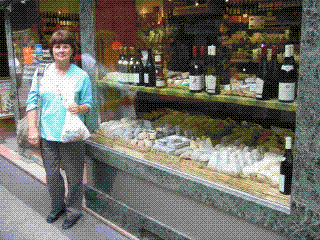
We've had some great Manchego and other cheeses in Mexico but the best goat milk cheese we ever had was from a shop on the Rue Cler in Paris last
year!
|
|
|
SteveD
Nomad
Posts: 106
Registered: 11-29-2007
Member Is Offline
|
|
Having trouble posting picture. Will try again!
|
|
|
Bajahowodd
Elite Nomad
Posts: 9274
Registered: 12-15-2008
Location: Disneyland Adjacent and anywhere in Baja
Member Is Offline
|
|
Really not wishing to hijack this thread. But Cheese is made from milk.
Poring over facts about milk: cow's, goat's, soy, almond, rice and hemp
Some are richer in protein, others in essential fatty acids. There are pros and cons to all.
A variety of "milks" and dairy substitutes, including, from left; rice milk, hemp milk, cow milk, soy milk, almond milk and goat milk. (Jay L.
Clendenin / Los Angeles Times)
Related
Graphic: What's in your milk
By Elena Conis >>>
October 19, 2009
E-mail Print Share Text Size
Full-fat, low-fat or skim? Used to be, there weren't many choices to make over what to pour on your cereal. But the number of alternatives to cow's
milk -- soy, goat's, hemp milk, more -- has steadily grown.
Each has its fans: those who swear by goat's milk's creamy texture or who love almond milk's subtle, nutty flavor. But when it comes to nutrition,
there's no clear winner.
Cow's milk is a good source of protein but can be high in saturated fats. Hemp milk offers little protein but is rich in certain essential fatty
acids. For some, an allergy is the main concern when choosing milk. For others, digestibility drives the decision. "There are dozens of differences in
all of these milks," says Alexandra Kazaks, professor of nutrition at Bastyr University in Kenmore, Wash.
Here's a look at the nutritional pros and cons of standards and newcomers in the dairy case. See Page E3
Cow's milk
Whole cow's milk packs 150 calories per cup, and about half of those calories come from fat. (See the related chart for a nutritional breakdown of all
these different milks.) The 8 grams of fat in a cup of whole milk includes 5 grams of saturated fat, which can raise blood cholesterol. The American
Heart Assn. recommends limiting saturated fat intake to 7% or less of daily calories: An adult consuming 1,800 calories per day would get more than
one-third of that in an 8-ounce glass of whole milk.
Skim and reduced-fat milks provide the same amount of protein without the high levels of saturated fats or the cholesterol whole milk also contains.
They also retain all of the calcium found in whole milk -- up to 300 milligrams, about one-third of the recommended daily intake. According to the
Institute of Medicine, adults require between 1,000 and 1,300 milligrams of calcium a day for optimum bone strength. And cow's milk has long been
promoted by nutritionists and dietitians as a good source of this important mineral, as well as the vitamin D needed to absorb the mineral.
But "there's a fair amount of controversy in that whole area," says Larry Kushi, associate director for epidemiology in the division of research at
Kaiser Permanente Northern California in Oakland. The issue is just how important calcium -- and milk as a source of calcium -- truly is for bone
health.
Scientists increasingly began to question the relationship after several studies, including two unusually large ones, failed to find evidence linking
increased milk consumption to a decreased risk of fractures, a sign of bone health.
A 12-year study of more than 77,000 women, conducted by Harvard researchers and published in 1997, found that women who drank two glasses of milk a
day had roughly the same risk of hip or forearm fractures as women who drank one glass or less per week. A 2003 investigation of the same population
found that although vitamin D intake reduced the risk of hip fractures in post-menopausal women, high calcium and milk intake did not.
The science on the relationship between cow's milk and cancer is also somewhat murky, and researchers are working to clarify this. Population studies
have produced good evidence that increased dairy consumption, including that of milk, may decrease the risk of colorectal cancer. But studies also
suggest that the risk of prostate cancer may increase with increasing milk consumption.
The evidence for female cancers -- including breast, ovarian and endometrial cancers -- is more mixed. Studies conducted several decades ago were less
likely to demonstrate a link between dairy consumption and female cancers than more recent ones, and some nutrition experts think this difference may
be linked to industrial practices that have increased the levels of the hormone estrogen in cow's milk.
Then there's the issue of milk allergy, an immune-system reaction to any of the several types of casein, whey or other proteins in milk. About 2.5% of
children develop cow's milk allergies in their first year, according to the National Institutes of Health, and 80% outgrow it in adulthood.
Other individuals suffer from lactose intolerance, the inability to digest the dominant sugar found in milk. The intolerance (which causes gas,
bloating and diarrhea) stems from a lack of lactase, the enzyme required to break down the milk sugar lactose. It is far more common than milk
allergy. "Most of the world's population can't digest milk," says Dr. Scott Sicherer, professor of pediatrics at the Jaffe Food Allergy Institute at
Mount Sinai School of Medicine in New York, and co-author of the 2009 book "The Complete Idiot's Guide to Dairy-Free Eating." "Our bodies are not made
to drink this stuff."
Goat's milk
The popularity in the U.S. of cow's milk makes us a bit of an anomaly: Globally, goat's milk is a far more popular drink.
But Americans may be getting a taste for it. Tracy Darrimon, director of marketing for Turlock, Calif.-based Meyenberg Goat Milk Products, the top
producers of commercially available goat milk in the U.S., says that over the last four years the company has increased production more than 30% to
keep up with demand.
Consumers choose goat's milk because they perceive it as less allergenic, easier to digest and more healthful all round than cow's milk. Some of those
perceptions may be wrong. Since goat's milk, like cow's milk, is derived from mammals, "It's much more likely to have similar effects on long-term
health," Kaiser's Kushi says.
Consumers looking to avoid saturated fat and cholesterol, for instance, may do well to eschew whole goat's milk: It has more saturated fat than cow's
milk and similar levels of cholesterol and is higher in calories and total fat. And goat's milk, like cow's milk, contains lactose. Though the levels
can be slightly lower than those in cow's milk, "It's not enough to really make a difference if someone has lactose intolerance," Bastyr's Kazaks
says.
In Europe, where goat's milk consumption is far more common than in the U.S., a few studies have suggested that goat's milk is less likely to cause
allergies than cow's milk. But Ohio allergist Dr. Julie McNairn, a spokesperson for the American Academy of Allergy, Asthma and Immunology, doubts
that this is true. She says the proteins triggering allergy to cow's milk are very similar to those found in goat's milk.
More than 90% of the time, people allergic to cow's milk are allergic to goat's milk, Sicherer adds: "If someone's allergic to cow's milk, I tell them
to stay away from mammalian milks."
Soy milk
Because soy milk is made from a plant, it contains no cholesterol and negligible amounts of saturated fat: just half a gram per cup.
Compared with whole cow's or goat's milk, it is lower in calories too, but a glass still provides the same levels of key nutrients present in those
milks, including calcium, protein, vitamin A, vitamin D and potassium. That's partly because soybeans contain calcium, protein and potassium. But soy
milk is also fortified to be nutritionally comparable to cow's milk.
Soy milk's lack of cholesterol and low levels of saturated and total fat have made it a popular choice for people looking to improve their heart
health, says Stacey Krawczyk, a research dietitian with the National Soybean Research Laboratory at the University of Illinois at Urbana-Champaign.
For the last 10 years, soy foods have been allowed to bear the FDA-approved claim that a low-fat, low-cholesterol diet containing 25 grams of soy
protein per day may reduce the risk of heart disease.
Soy milk may have another benefit: In recent decades, several large population studies have suggested consuming soy may be linked to a lower risk of
cancer, including prostate, colorectal and breast cancer.
But the relationship between soy milk consumption and cancer remains unclear -- largely because most studies have focused on populations, such as
those in Asia, that consume whole soy products, such as tofu, tempeh and edamame, as a large part of their diet. Studies on the general U.S. and
European populations have not been able to replicate the findings, in part because soy consumption levels here are much lower, Kushi says.
This protective effect against cancer, if there is one, is thought to be at least partly due to estrogen-like compounds in soy that may compete with
human estrogen in the body, hindering it from prompting the cell proliferation that can trigger cancer. But the link between soy consumption and
cancer may invert in women after menopause, when natural estrogen levels plummet. "The evidence is still unclear," Kushi says.
Soy can be a good dairy alternative for most people with allergies to cow's milk. Soy allergies affect 0.4% of children -- more common than most food
allergies but far less common than ones to milk. Soy milk allergy in children is often outgrown. And though people allergic to cow's milk are often
likely to have another food allergy, the differences in the two milks' proteins means an allergy to one doesn't automatically translate into an
allergy to the other, McNairn says.
Soy milk also lacks lactose, so it's easier for people with lactose intolerance to digest it.
A downside? Because soybeans have an inherently bitter taste, soy milk is often heavily processed -- and sweetened -- to mask that flavor, says Kantha
Shelke, a food chemist with the Chicago-based food-science think tank Corvus Blue. Sweeteners are often high on the list of ingredients in soy milks,
adding sugar and calories that consumers might not be aware of. Still, with about 5 grams of sugar per cup, even the more sugary soy milks contain
fewer sugars than the 12 grams per cup in cow's milk. (Soy milks labeled "unsweetened" contain about 1 gram.)
Soy milk presents its own digestibility challenges, Kazaks says. The milk contains high levels of oligosaccharides, carbohydrates that are hard for
the body to break down. "It can really cause a lot of gas in some people," she says.
Almond milk
"With almond milk, it's more about what you don't get" than what you do, says Sam Cunningham, an independent food scientist and consultant
specializing in nuts, who helped develop almond milk for Sacramento-based Blue Diamond Growers as an employee of the almond processor in the 1990s.
Like soy milk, almond milk contains zero cholesterol. It's free of saturated fats, so it's a healthful option for people with, or at risk for, heart
disease. It doesn't contain lactose, so it's an option for people with lactose intolerance. And it's even lower in calories and total fat than soy
milk: a glass contains just 60 calories and 2.5 grams of fat to soy milk's 100 calories and 4 fat grams.
But although almonds, among nuts, are a good source of calcium and protein, almond milk's calcium and protein levels don't compare to the levels in
cow's, goat's or soy milks. A glass of almond milk provides just 1 gram of protein. Some brands provide up to 20% of the daily recommended calcium
intake (about 10% less than the other milks), but other brands provide none.
Almonds are also a good source of iron, riboflavin, vitamin E and some essential fatty acids. A cup of the ground-up nuts contains more than 11 grams
of omega-6 fats (but very few omega-3s).
In recent years, several studies have hinted at a link between nut consumption and lower blood cholesterol and a reduced risk of heart disease. Since
2003, the Food and Drug Administration has allowed almonds (and other nuts) to bear the claim that eating 1.5 ounces of nuts daily, as part of a diet
low in saturated fat and cholesterol, may reduce risk of heart disease.
Still, nuts are one thing -- almond milk is another. The fraction of almond milk that's actually comprised of finely blended almonds varies between
products and can be minimal, Kazaks says. In many commercially available almond milks, almonds are the second or third ingredient, after water and
sweeteners. (The same is true for many soy milks as well.) So despite the high vitamin E and omega-6 content of almonds, a glass of almond milk may
contain none of the vitamin and just 300 to 600 milligrams of the omega-6s.
Almond milk is a fine alternative for people allergic to cow's and soy milks, Jaffe's Sicherer says, but almonds pose their own allergenicity hazards.
Allergies to tree nuts, including almonds, are among the top allergies in the population, affecting 0.2% of children. And although cow's and soy milk
allergies are often outgrown, nut allergies are more likely to persist.
Rice milk
Like almond milk, rice milk's main advantages are what it doesn't contain. It is free of cholesterol and saturated fat. It doesn't contain lactose.
Allergies to rice are rare.
In fact, rice milk manufacturers commonly promote their product as safe for people with any of a number of allergies or intolerances -- including
cow's milk, soy and nut allergies, as well as lactose and gluten intolerance. (Gluten, found in wheat and other cereal grains, is not present in any
of the milks mentioned here.)
Rice milk, like soy and almond milk, is formulated to contain levels of calcium, vitamin A and vitamin D similar to (albeit lower than) those in cow's
milk. But it is not a good source of protein, with just 0.67 grams per serving, and often contains more calories than almond or soy milk: about 113
calories per cup. Its vitamin E levels exceed that of cow's, goat's and soy milk but don't compare with that of some almond milks.
One more thing rice milk doesn't have: flavor in need of masking with sweeteners. "It's a very mild-flavored product," Corvus Blue's Shelke says.
Hemp milk
Among plant-based milks, hemp milk is unique, and not just because the cannabis plant it's made from poses legal challenges for farmers.
A glass of hemp milk contains the same number of calories as soy milk, one-third to one-half of the protein, but 50% more fat: 5 to 6 grams. However,
most of the fats in hemp milk are omega-3 and omega-6 essential fatty acids, key for nervous system function and healthy skin and hair. Certain
omega-3 and omega-6 fats also appear to reduce inflammation and lower blood lipid levels.
Plant oils typically have an excess of omega-6 fats relative to omega-3s -- and the hemp seed is no exception. A cup of hemp milk (which is made from
the "nut" of the hemp seed but can also contain some of the hull) often provides about 1 gram of omega-3s and 3 to 4 grams of omega-6s. Still, that
level of omega-3s is high for plants, making hemp milk a useful source of them -- especially given that American diets typically provide too few
omega-3 fats and too many omega-6s.
In fact, some nutrition experts recommend a dietary ratio of omega-3s to omega-6s of between 1:1 and 1:3, a ratio that occurs naturally in hemp milk.
But the story is more complicated than that. It is unclear whether the predominant omega-3 fat in hemp, alpha linolenic acid (ALA), has the same
heart-health benefits of those found abundantly in fish oils (known as EPA and DHA for short), says William Harris, director of the Cardiovascular
Health Research Center at the University of South Dakota.
Like soy milk, hemp milk is low in saturated fat and cholesterol-free. It's also free of lactose, and allergies to hemp are rare. Christina Volgyesi,
vice president of marketing for Portland, Ore.-based Living Harvest Foods, which makes hemp milk, says the milk is made from different cannabis
varieties than those used to produce marijuana, and contains none of the mind-altering active ingredient THC.
Hemp milk contains many of the nutrients found in cow's milk (including calcium, vitamin A and vitamin D) since it's fortified. In fact, some brands
provide 40% to 50% of the daily recommended allowance of calcium, as compared with the 30% found in cow's milk.
Nutritionally, hemp seeds are similar to flax seeds, which have become increasingly popular sources of essential fatty acids in recent years. But not
all seeds rich in the fats lend themselves to a palatable milk alternative.
"Flax milk would probably be dark brown," Shelke says. "We are probably not prepared to drink something dark brown in color."
Unless, of course, it's chocolate milk -- be it of cow's, goat's, soy, almond, rice or even hemp.
health@latimes.com
Copyright © 2009, The Los Angeles Times
|
|
|
tripledigitken
Ultra Nomad
Posts: 4848
Registered: 9-27-2006
Member Is Offline
|
|
| Quote: | Originally posted by Bajahowodd
I happen to partial to Manchego, which in its original form is a goat milk cheese made in Spain. I've see Cacique in the LA area labeling a cheese
Manchego, but the ingredient list just says milk. I assume it's cow's milk. That said, I've bought a tasty Manchego at Walmart in both Ensenada and
Cabo Walmarts. However, what they sold, both sliced and chub was repackaged and didn't have ingredients listed. Trader Joe's sells Spanish Manchego,
buy it's rather pricey.
[Edited on 10-19-2009 by Bajahowodd] |
All of the Spanish Manchego Cheese I have bought was made from sheep's milk.
Ken
|
|
|
Bajahowodd
Elite Nomad
Posts: 9274
Registered: 12-15-2008
Location: Disneyland Adjacent and anywhere in Baja
Member Is Offline
|
|
My Gawd! I goofed. You are correct sir. Thanks for pointing that out. Time for another shock treatment.
|
|
|
tripledigitken
Ultra Nomad
Posts: 4848
Registered: 9-27-2006
Member Is Offline
|
|
I'm a big fan of it myself and can't think of a better appetizer than some Manchego slices and Serrano Ham with some crispy bread washed down with
Sangria!!
Through in some Flamenco Guitar music also.
Ken
|
|
|
Bajahowodd
Elite Nomad
Posts: 9274
Registered: 12-15-2008
Location: Disneyland Adjacent and anywhere in Baja
Member Is Offline
|
|
Actually Ken, I just realized what prompted me to make that egregious error. I had just finished reading the article I posted that talked about goat
milk being the preferred source in much of the world. And I wholeheartedly agree that Manchego rocks!
|
|
|
Oggie
Nomad
Posts: 312
Registered: 6-16-2009
Location: Carlsbad, CA/BOLA
Member Is Offline
Mood: Missing Baja
|
|
When we are traveling south, we stop at the cheese shop just north of San Vicente, BCN. They have several varieties from soft to hard. They are very
good and made right there.
A man never stands as tall as when he kneels to help a child.
Knights of Pythagoras
Funny how falling feels like flying
for a little while - Bad Blake
|
|
|
BajaNuts
Super Nomad
Posts: 1085
Registered: 5-11-2008
Location: eastern WA, the DRY side
Member Is Offline
Mood: no worry, no hurry....it's all good!
|
|
there's milk from cows and goats, as mentioned.
Also sheep, llama, yak, chicken and camel. Probably, a couple more I've forgotten.
Manchego is yummy! Someday, it would be fun to have a Mexican cheese sampling event.
|
|
|
BajaNuts
Super Nomad
Posts: 1085
Registered: 5-11-2008
Location: eastern WA, the DRY side
Member Is Offline
Mood: no worry, no hurry....it's all good!
|
|
here's a link to a Mexican Cheeses Guide-
http://www.mexconnect.com/articles/2155-a-guide-to-mexican-c...
And another one-
http://mexican-food.suite101.com/article.cfm/cheeses_of_mexi...
The second one is copyrighted, but if someone is interested, you can copy the text for your own personal use, paste it into a WordDoc and print it out
for reference.
Edit- It looks like the mexconnect one is probably copyrighted also. Just print it for your own use.
[Edited on 10-19-2009 by BajaNuts]
|
|
|
Sunman
Nomad
Posts: 400
Registered: 6-22-2007
Location: Oxnard
Member Is Offline
|
|
| Quote: | Originally posted by Oggie
When we are traveling south, we stop at the cheese shop just north of San Vicente, BCN. They have several varieties from soft to hard. They are very
good and made right there. |
LaLa's...excellent varieties of queso, her totrtillas ain't too shabby either.
|
|
|
Paula
Super Nomad
Posts: 2219
Registered: 1-5-2006
Location: Loreto
Member Is Offline
|
|
I like the Oaxacan regional ( is that an oxymarooon or an anomaly?) sold at Pescador in Loreto, especially heated in Salsa verde. I think it is made
in Constitucion.
But the best cheese is bought at the ranches-- queso fresca de chiva. Rancho Viejo on the way to San Javier has wonderful cheese. Really good as a
dessert with membrillo or other ates. And the best of the best is the slightly dryer aged queso fresca from Rancho Calabazas in the Sierra San
Francisco. And fresh queso de chivo made by Gloria Leree at Rancho Guadalupe. Nothing like it anywhere, you can taste the desert plants that the
goats feed on in the cheese!
Might be worth a trip south, and a ride in the Sierra, Jan
edited for typos
[Edited on 10-20-2009 by Paula]
|
|
|
Timo1
Senior Nomad
Posts: 764
Registered: 11-2-2007
Location: Homeless
Member Is Offline
Mood: Lovin every minute of it
|
|
| Quote: | Originally posted by BajaNuts
there's milk from cows and goats, as mentioned.
Also sheep, llama, yak, chicken and camel. Probably, a couple more I've forgotten.
Manchego is yummy! Someday, it would be fun to have a Mexican cheese sampling event. |
|
|
|
Timo1
Senior Nomad
Posts: 764
Registered: 11-2-2007
Location: Homeless
Member Is Offline
Mood: Lovin every minute of it
|
|
oooooops.....chicken milk ?????
|
|
|
Von
Senior Nomad
Posts: 961
Registered: 10-1-2006
Location: Poway-Rosarito
Member Is Offline
Mood: getting ready!
|
|
Toe cheese lol hahahahaha just had to say it~~ lol hahahahaha just had to say it~~
READY SET.....................
|
|
|
BajaNuts
Super Nomad
Posts: 1085
Registered: 5-11-2008
Location: eastern WA, the DRY side
Member Is Offline
Mood: no worry, no hurry....it's all good!
|
|
Timo,
SI! do you know how to milk a chicken? VERY CAREFULLY!
and I knew there was one I was forgetting....guinea pig! Yes, you can milk a guinea pig!
Timo is on the toes! (well spotted, amigo) [that only took about 8 hours...]
OH YEA! Von, I'm not sure but I think it's toe jam.....????
|
|
|
BajaNuts
Super Nomad
Posts: 1085
Registered: 5-11-2008
Location: eastern WA, the DRY side
Member Is Offline
Mood: no worry, no hurry....it's all good!
|
|
Yes, I do love cheese and I love being cheesy!
(hear hubby groan in the background at my cheesy/corny jokes...)
aside from that...........MORE CHEESE!
SERIOUSLY THOUGH>>>>>>>>
I've been buying different cheeses for us to sample and I'm happy that the 5th grader still samples new flavors. I'm looking forward to traveling and
sampling/buying cheeses in Baja with a lot more basic knowledge than we had before.
|
|
|
grmpb
Nomad
Posts: 103
Registered: 5-24-2009
Member Is Offline
|
|
| Quote: | Originally posted by Oggie
When we are traveling south, we stop at the cheese shop just north of San Vicente, BCN. They have several varieties from soft to hard. They are very
good and made right there. [/quot
i'll be going through there soon. can you give us more detailed directions? |
|
|
|
| Pages:
1
2 |
|





![[*]](images/xmbforum/default_icon.gif)