windgrrl
Super Nomad

Posts: 1336
Registered: 9-2-2006
Member Is Offline
|
|
Border Crossing Answers: US C&BP
US Customs & Border Protection answers to questions about crossing into the US re: common questions about personal items, human food, pet food,
etc. Gives rationale and examples and hyperlinks to related topics, too:
https://help.cbp.gov/app/answers/detail/a_id/82/related/1
[Edited on 9-14-2011 by windgrrl]
When the way comes to an end, then change. Having changed, you pass through.
~ I-Ching
|
|
|
BornFisher
Super Nomad
Posts: 2138
Registered: 1-11-2005
Location: K-38 Santa Martha/Encinitas
Member Is Offline
|
|
Someone I know was bringing some salami back and WHOAAAAAAA.................. FINED $300!!!! Got it down to $175 but I was shocked. I thought they
would just take the salami and toss it away! This happened about a month ago.
So check your coolers or get out your Visa card out and pay a fine.
|
|
|
Dave
Elite Nomad
Posts: 6005
Registered: 11-5-2002
Member Is Offline
|
|
| Quote: | Originally posted by BornFisher
Someone I know was bringing some salami back and WHOAAAAAAA.................. FINED $300!!!! |
You mean because it wasn't declared, right?
|
|
|
BornFisher
Super Nomad
Posts: 2138
Registered: 1-11-2005
Location: K-38 Santa Martha/Encinitas
Member Is Offline
|
|
Dave-- I would assume she did not declare it. They probably lifted the cooler top and "Shazammmmm! What have we got here?".
Maybe I`m wrong, but didn`t they used to just give you a lecture and toss the stuff? Wonder how much a pack of hot dogs would set you back?
|
|
|
David K
Honored Nomad
Posts: 65634
Registered: 8-30-2002
Location: San Diego County
Member Is Offline
Mood: Have Baja Fever
|
|
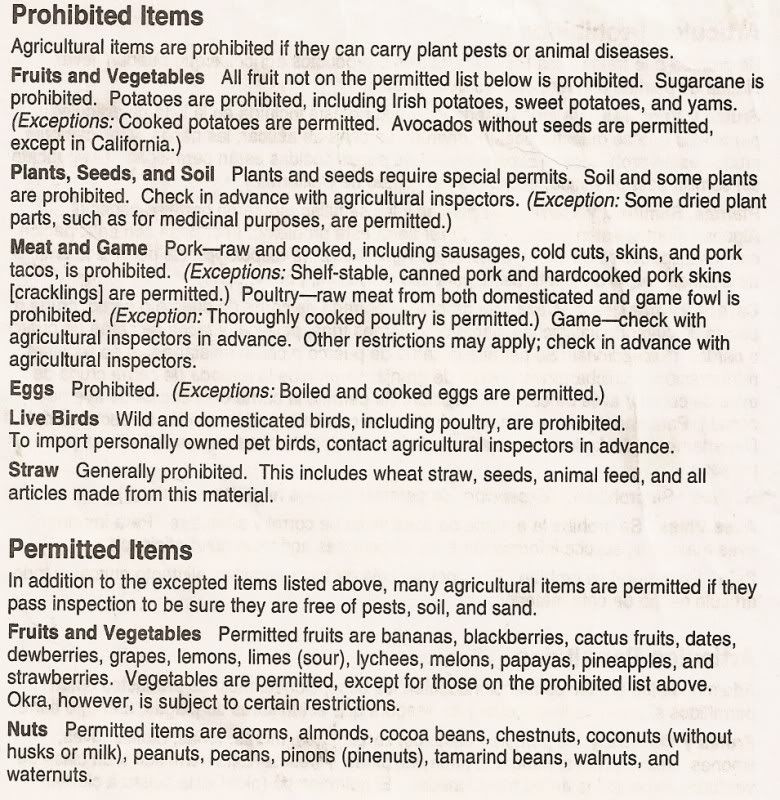
NO PORK, CHICKEN or EGGS... no matter what country it came from. Naturally, unopened packages of sandwich meat is clean and ok... but some border
officers don't bother to read the rules.
LIMES are OK, but a new agent at the border sent me to secondary because he knew some citrus (like oranges) are not permitted... The secondary ag
officer laughed at seeing 'limes' written on the tag and sent me on my way.
I have posted the list for returning from Mexico... but it is about 10 years old... and I haven't been able to find a newer one.
Here it is:
|
|
|
windgrrl
Super Nomad
Posts: 1336
Registered: 9-2-2006
Member Is Offline
|
|
"Travelers bringing food into the U.S. for personal use"
I have posted the list for returning from Mexico... but it is about 10 years old... and I haven't been able to find a newer one.
Here's what you can bring over the line...as of today's US C&BP website.
The information contained in this answer does not apply to food being sent to the U.S. through the mail, courier services or other means. This
information only covers food (fruit, cheese, meat, etc.) entering the United States in passenger baggage for personal use. See the question "How do I
import food (canned goods, meat, vegetables, fruits, bulk food, etc.) for resale?" for information on importing food for resale.
You may be able to bring in food such as fruits, meats or other agricultural products depending on the region or country from which you are traveling.
Restrictions are placed on these products to protect community health, preserve the environment and prevent the introduction of devastating diseases
to domestic plants and animals.
Failure to declare food products can result in up to $10,000 in fines and penalties.
The following are generally admissible:
-Condiments such as ketchup (catsup), mustard, mayonnaise and prepared sauces that do not contain meat products
-Olive oil and other vegetable oils
-Bread, cookies, crackers, cakes, granola bars, cereal and other baked and processed products
-Candy and chocolate
-Cheeses- Solid cheese (hard or semi-soft, that does not contain meat), butter, butter oil, and cultured milk products such as yogurt and sour cream
are not restricted. Feta cheese, Brie, Camembert, cheese in brine, Mozzarella and Buffalo Mozzarella are permissable (USDA Animal Product Manual,
Tabel 3-14-6). Cheese in liquid (such as cottage cheese or ricotta cheese) and cheese that pours like heavy cream are not admissible from countries
affected by foot-and-mouth diesease (FMD). Cheese containing meat is not admissible depending on the country of origin.
-Canned goods and goods in vacuum packed jars (other than those containing meat or poultry products) for your personal use
-Fish- personal amounts of fish, shrimp, abalone and other seafood are allowed and can be fresh, frozen, dried, smoked, canned or cooked
-Powder drinks sealed in original containers with ingredients listed in English. However, admissibility is still under the discretion of the Customs
and Border Protection (CBP) Agricultural Specialist.
-Dried Fruit- things like apricots, barbery, currants, dates, figs, gooseberries, peaches, prunes, raisins, tomatillos, and zereshk (USDA
Miscellaneous and Processed Products Manual, Table 3-69)
-Liquid milk and milk products intended for use by infants or very young children are admissible if in a reasonable amount or small quantity for
several days' use
-Juices- commercially canned (USDA Miscellaneous and Processed Products Manual, Table 3-75)
-Tea- commercially packaged and ready to be boiled, steeped or microwaved in liquid. Coca, barberry and loose citru leaves are prohibited (USDA
Miscellaneous and Processed Products Manual, Table 3-148)
-Coffee- roasted or unroasted if there is no pulp attached. (USDA Miscellaneous and Processed Products Manual, Table 3-48)
-Spices- most dried spices are allowed except for orange, lemon, lime and other citrus leaves and seeds, lemongrass, and many vegetable and fruit
seeds
-Honey- comb honey, royal jelly, bee bread, or propolis if it is not intended to be fed to bees (USDA Miscellaneous and Processed Products Manual,
Table 3-94)
-Noodles and ramen that do not have meat or eggs in the spice packets
-Rice- (See ALERT below) white rice, basmati rice, brown rice, husked rice, polished rice, rice flour and other products that do not have the hull
attached (USDA Miscellaneous and Processed Products Manual, Table 3-130). ALERT: Effective July 30, 2011 non-commercial quantities of rice from
countries where Khapra beetle is known to occur will be prohibited from entering the United States. Failure to declare rice will result in fines.
-Flour- wheat, rice, oat and cornmeal
-Mushrooms, fresh and dried- above ground parts that are clean and free of soil
-Nuts- All nuts are allowed if they have been boiled, cooked, ground, oven dried, pureed, roasted, or steamed. Other nuts may be allowed if they are
free from their husks (the shell remains), such as almonds, betel nuts, Brazil nuts, cashews, coquilla nuts, filberts (hazelnuts), Java olives, kara
nuts, gingko nuts, macadamias, pecans, pili nuts, pine nuts (pinon nuts), pistachios, and walnuts. (USDA Miscellaneous and Processed Products Manual,
Table 3-105, 3-106)
-Bakery items, candy, chocolate, and dry mixes containing dairy and egg ingredients [such as baking mixes, cocoa mixes, drink mixes, instant cake
mixes, instant pudding mixes, liquid drink mixes containing reconstituted dry milk or dry milk products (including those that contain sugar), potato
flakes, and infant formula] commercially labeled and presented in final finished packaging are generally admissible.
Fruits and Vegetables:
Travelers may check the general admissibility of fruits and vegetables by consulting APHIS's FAVIR database at http://www.aphis.usda.gov/favir/. Simply select the type of fruit or vegetable in the "Approved Name:", and then select the country of origin in
the "Country/Region:" field. You will receive one of the following results:
· 0 entries found means the fruit or vegetable is NOT allowed into the United States
· # entry(ies) found [followed by the name of the commodity and the name of the country] click on "CIR".
o If the import requirements indicate: 1 Subject to Inspection: This commodity is subject to inspection at the port of entry and all general
requirements of 7 CFR 319.56-3. The fruit or vegetable is allowed into the United States pending Inspection.
o If the import requirements indicate: Condition of entry treatment then the fruit or vegetable is NOT allowed into the United States in passenger
baggage.
Every fruit or vegetable must be declared to a CBP Agriculture Specialist or CBP Officer and must be presented for inspection - regardless of its
admissibility status. Fresh fruits and vegetables need to be clean and may be prohibited if they have insects or diseases.
Note: See FDA Web site Food products imported from Japan and radiation safety.
The following items are admissable:
-aloe- above ground parts
-coconuts-husks must have been completely removed and cannot have sprouted
-garlic- peeled cloves
-ginger- clean roots
-St. John's bread- pod
-tamarind bean pod
-water chestnut- corm or nut only
Animal Products and Animal By-Products:
Meat, milk, egg, poultry, and their products, including products made with these materials, such as dried soup mix or bouillon, are either prohibited
or restricted from entering the United States, depending on the types of animal diseases which occur in the country of origin. Fresh (chilled or
frozen), dried, cured, and fully cooked meat is generally prohibited from most countries. Canned meat is allowed entry, except beef, veal, lamb,
mutton, venison, elk, bison, etc., from countries affected by bovine spongiform encephalopathy (BSE).
Products containing raw egg ingredients are prohibited from most regions.
Eggs and egg products from Exotic Newcastle Disease (END) and Highly Pathogenic Avian Influenza (HPAI) affected regions, including cooked eggs, if not
accompanied by a USDA Veterinary Service import permit remain prohibited regardless if those items are for personal consumption. There is no
exception for cooked eggs from Mexican states of Sonora or Sinaloa.
Pork should be commercially canned and labeled in unopened containers. Pork and pork products are not admissible from Mexico, except for cooked pork
in small amounts for a meal.
Effective January 14, 2010, cooked pork skins (also known as pork rind) entering as commercial cargo or in passenger baggage from regions affected
with foot-and-mouth disease (FMD), swine vesicular disease (SVD), African swine fever (ASF), or classical swine fever (CSF) must be accompanied by an
original certificate issued by an official of the National Government of the region of origin.
Canadian Agricultural Products:
For fruits and vegetables from Canada, consult the FAVIR Database at http://www.aphis.usda.gov/favir/.
Fruits and vegetables grown in Canada are generally admissible, if they have labels identifying them as products of Canada. Fruits and vegetables
merely purchased in Canada are not necessarily admissible, i.e. citrus or tropical fruits such as mangos, which clearly were not grown in Canada
because it does not have a climate that supports those crops. (Potatoes from western regions of Canada are currently restricted because of a disease
outbreak. While commercial imports are permitted under stringent guidelines, travelers from Canada should avoid bringing raw potatoes with them into
the U.S.).
Food products from Canada, including pet food and fresh (frozen or chilled), cooked, canned or otherwise processed products containing beef, veal,
bison, and cervid (e.g. deer, elk, moose, caribou etc.) are now permitted from Canada in passenger baggage. Products containing sheep, lamb, or goat
will not be allowed entry.
The passenger must provide proof of the origin of beef, pork, poultry, cervid meat, and pet food in order to bring them into the United States.
Examples of proof of origin include the grocery store receipt where the product was purchased or the label on the product indicating the province in
which it was packaged.
Hunter harvested game birds (pheasant, quail, goose, etc.) or cervid carcasses (e.g. deer, moose, elk, caribou, etc.) from Canada are allowed entry
when importers present to the Customs and Border Protection officer evidence such as a hunting license that the product is hunter harvested wild game.
Hunter-harvested wild non-cervid animal (e.g. wild sheep, goats, or bison/buffalo, etc.) meat or carcasses, which must be eviscerated and head
removed, are allowed when the hunter shows to CBP officers a hunting license, tag, or equivalent.
Mexican Eggs/Poultry:
The regulations regarding bringing cooked poultry-such as chicken and turkey-meat, including deli-sliced poultry meat, and cooked, hard-boiled eggs
into the U.S. from Mexico have changed. The U.S. Department of Agriculture Animal and Plant Health Inspection Service informed CBP that APHIS is
implementing new requirements for processed (including cooked) poultry meat and cooked, hard-boiled eggs brought by passengers arriving from regions
where APHIS considers Exotic Newcastle Disease (END) to exist. Currently, Mexico is a country recognized by APHIS as being affected by END.
According to the new requirements, processed poultry meat brought by passengers arriving from Mexico or from any region classified by the USDA as
affected with END or HPAI must be accompanied by government certification confirming that the meat was cooked to a minimum internal temperature of 74
degrees centigrade. This requirement is for all poultry meat (excluding canned, hermetically sealed, shelf stable meat), poultry meat products, and
poultry products. There is no exception for cooked eggs from the Mexican states of Sinaloa and Sonora.
Certification of poultry having been cooked at a temperature of at least 74 degrees centigrade does not apply to poultry meat products intended for
personal consumption (poultry meat and meat products in passenger baggage or carry-on, personal meals). For movement into the U.S., CBP officials
must still visually inspect these items to certify that poultry meat and poultry products in checked or carry-on passenger baggage or in meals, from
END or HPAI affected regions, for personal consumption appear thoroughly cooked throughout. Amounts greater than 50 pounds found in passenger baggage
are considered commerical and will require a USDA APHIS Veterinary Services certificate as part of the entry packet.
Further Information:
Other then the above general guidelines, it is impossible to advise you in this forum about the admissibility of specific food items because it is so
susceptible to change. Disease and pest outbreaks which impact the admissibility status of fresh and packaged food items may occur all over the world
at any time.
The USDA establishes criteria for the admissibility of plant, dairy, meat and other animal products returning with travelers and they make the
determination for what may be admitted into the U.S. For more detailed information, visit the USDA Animal and Plant Health Inspection Service (APHIS)
Web site. If you have any questions, or require further information related to imports of specific animal products or by-products, please contact
National Center for Import and Export at AskNCIE.Products@aphis.usda.gov.
All commercial and personal imports of products from endangered species and other wildlife are subject to FWS permit requirements. For more
information, please call the FWS at (703) 358-2093.
CBP Agricultural Inspectors are stationed at ports of entry and along our land and sea borders. Because of the complexities of regulations governing
the importation of food they may need to contact specific agencies for information about what is or is not admissible. If no expert is available, food
may be detained in the interest of preventing possible outbreak of foreign diseases in the U.S.
https://help.cbp.gov/app/answers/detail/a_id/82/related/1
When the way comes to an end, then change. Having changed, you pass through.
~ I-Ching
|
|
|
sancho
Ultra Nomad
Posts: 2524
Registered: 10-6-2004
Location: OC So Cal
Member Is Offline
|
|
There was a couple posts re: crossing into Ariz. a
while back, 2 incidents of travelers coming back with
1 avocado/ orange, I assume they forgot they
had them, I can't imagine purposefully smuggling
2 pieces of fruit, they were fined in that same range
$275- $300
|
|
|
Jim/Liisa
Nomad
Posts: 192
Registered: 2-5-2011
Location: San Felipe (South Campos)
Member Is Offline
|
|
| Quote: | Originally posted by David K
NO PORK, CHICKEN or EGGS... no matter what country it came from. Naturally, unopened packages of sandwich meat is clean and ok... but some border
officers don't bother to read the rules.
LIMES are OK, but a new agent at the border sent me to secondary because he knew some citrus (like oranges) are not permitted... The secondary ag
officer laughed at seeing 'limes' written on the tag and sent me on my way.
I have posted the list for returning from Mexico... but it is about 10 years old... and I haven't been able to find a newer one.
Here it is:
|
David,
Do you happen to know what is allowed crossing over to the Mexico Side?
|
|
|
DaleG
Junior Nomad
Posts: 45
Registered: 9-14-2011
Member Is Offline
|
|
Had to chuckle when I read "soil" on the list. Once I got tossed into secondary because I had too much MUD on my truck. Seriously. Somethings about
"spores"...blah blah blah. They made me scrape it all off with a credit card.
What a bunch of power crazed cowboys.
|
|
|
BajaBlanca
Select Nomad
Posts: 13247
Registered: 10-28-2008
Location: La Bocana, BCS
Member Is Offline
|
|
too much mud ???? that's a first ....
welcome DaleG to Baja Nomads.
|
|
|
Dave
Elite Nomad
Posts: 6005
Registered: 11-5-2002
Member Is Offline
|
|
| Quote: | Originally posted by BornFisher
Dave-- I would assume she did not declare it. They probably lifted the cooler top and "Shazammmmm! What have we got here?".
Maybe I`m wrong, but didn`t they used to just give you a lecture and toss the stuff? Wonder how much a pack of hot dogs would set you back?
|
They can be dicks if they wanna. The rule says: Declare all items acquired outside of the U.S. I once had an inspector find
one bottle of tequila and asked why I didn't declare it.
|
|
|
woody with a view
PITA Nomad
Posts: 15940
Registered: 11-8-2004
Location: Looking at the Coronado Islands
Member Is Offline
Mood: Everchangin'
|
|
crazy. no meats, yet cooked pork in amounts for a meal are okay? no beef or chicken tamales? they suck!
i guess i'll just give away all my stuff before i head north, as usual.
|
|
|
tiotomasbcs
Super Nomad
Posts: 1837
Registered: 7-30-2007
Location: El Pescadero
Member Is Offline
|
|
"Cowboys"!!! Ex Marines or cops who thrive on Power trips. I empty everything before returning. Last time they wanted my driftwood window
decorations? Glad I didn't bring my Eagle feathers with me, ha, ha! Tio
|
|
|
nbacc
Senior Nomad
Posts: 770
Registered: 12-27-2008
Location: Northern California
Member Is Offline
|
|
Bring nothing!!!!!!!! not even dog food unopened. /then you can say you have nothing. No fine, no hold up...........quick stop at Walmart to buy dog
food for the trip home! Nancy
|
|
|
|





![[*]](images/xmbforum/default_icon.gif)


