LaPazGringo
Nomad

Posts: 237
Registered: 2-28-2012
Location: La Paz
Member Is Offline
|
|
Large Great White Shark caught?
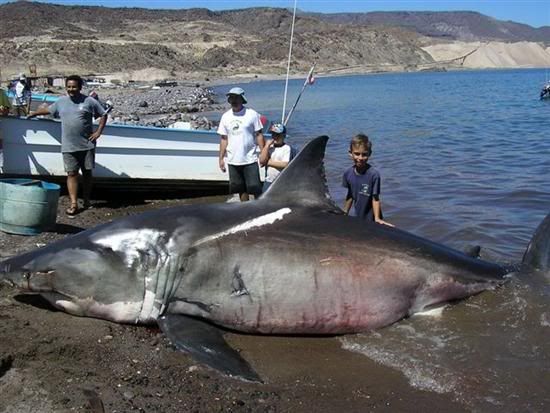
A gringo fisherman was telling me the other day when I was in La Paz that the big news is that a 3k lb. Great White was caught recently. I forget now
where he said, but it was either Bay of LA or Mulege. Does anyone know anything about that?
|
|
|
Mula
Super Nomad
Posts: 1665
Registered: 8-16-2011
Location: San Nicolas y Lopez Mateos
Member Is Offline
|
|
Sure, Sea of Cortez between Mulege and Loreto.
Jaws have already been sold.
|
|
|
Trueheart
Nomad
Posts: 155
Registered: 1-31-2010
Member Is Offline
|
|
Details anyone? Photos?
|
|
|
Pompano
Elite Nomad
Posts: 8194
Registered: 11-14-2004
Location: Bay of Conception and Up North
Member Is Offline
Mood: Optimistic
|
|
We were told local panga fishermen out of San Nicolas killed them. A fellow showed us photos of the great whites and the jaws last night at Ana's and
related his observations at San Nicolas. The biggest set of jaws sold for a rumored 1000 USD. Others for a mere 25 USD. Seems there has been a lot
of shark activity near IlleDelfonso.
I mentioned the rarity of great whites and their protection..he said they were not a threatened species anymore and were quite numerous in the
Cortez..which is news to me? He also mentioned his opinion that the pangueros had to eat and feed thier families, thus justifying the killing of the
great whites and other sharks.
The fellow, a diver, reported that many have been taken there lately...over 15 in one episode. One great white female with 15 unborn pups. Plus a
few makos and other shark species??
I do not have any photos to show, as this is a distastful subject to me.
Perhaps he will read this and respond with further information to clarify all these unsubstantiated rumors?
I do what the voices in my tackle box tell me.
|
|
|
LaPazGringo
Nomad
Posts: 237
Registered: 2-28-2012
Location: La Paz
Member Is Offline
|
|
I had always assumed that Whites wouldn't want anything to do with the warmer waters of the Cortez but since seeing that episode of the Shark Men
where those guys had tracked a White all the way north of San Felipe, I've seen several reports of apparently increasing populations of these guys. Do
scientists not know enough about the species to even know if populations are increasing, or if encounters are just more common?
My biggest question is why they don't feed at Los Islotes? I asked Arturo (of Marlin Adventures) about it and he's never seen one and he's been out
there virtually every day for 7 yrs. He said he heard a rumor that a small White had been spotted back in the mid-90s but nothing since then.
|
|
|
Pompano
Elite Nomad
Posts: 8194
Registered: 11-14-2004
Location: Bay of Conception and Up North
Member Is Offline
Mood: Optimistic
|
|
LaPazGringo...it seems that from all these 'rumors' that the great white is indeed becoming more numerous in the Cortez..at least the areas near Ille
Delfonso. Again, I have nothing scientific or factual to back these rumors up.
I do what the voices in my tackle box tell me.
|
|
|
LaPazGringo
Nomad
Posts: 237
Registered: 2-28-2012
Location: La Paz
Member Is Offline
|
|
But are they becoming more numerous, or are encounters just becoming more common? If they are multiplying here, is that necessarily good for the
ecosystem? I wonder if anyone is actually studying this?
|
|
|
Cypress
Elite Nomad
Posts: 7641
Registered: 3-12-2006
Location: on the bayou
Member Is Offline
Mood: undecided
|
|
| Quote: | Originally posted by LaPazGringo
But are they becoming more numerous, or are encounters just becoming more common? If they are multiplying here, is that necessarily good for the
ecosystem? I wonder if anyone is actually studying this? |
More pangas, more nets, more hooks 24/7/364= more encounters. They'll study 'em on their tacos before their next bite.
|
|
|
sancho
Ultra Nomad
Posts: 2524
Registered: 10-6-2004
Location: OC So Cal
Member Is Offline
|
|
| Quote: | Originally posted by Pompano
He also mentioned his opinion that the pangueros had to eat and feed thier families, thus justifying the killing of the great whites and other
sharks.
|
There is the age old quandry, and it is hard if not impossible
to argue with that. I believe GW's are found in
many Seas, off No. Calif, Guadalupe Isle 250 mi.
or so southwest of Ensenada has a transient
population of large Whites, they do shark cage
diving there, So. Africa. They are protected by
Ca Fish and Game in Ca
|
|
|
angels4
Nomad
Posts: 124
Registered: 9-12-2011
Member Is Offline
|
|
Very interesting story. Could it be that the GWs are becoming hybrid sharks? There was a story not too long ago that the Australian Blacktip sharks
were changing to better adapt to warmer waters. Maybe the Great Whites are doing the same...
http://www.washingtonpost.com/national/health-science/first-...
|
|
|
baitcast
Super Nomad
Posts: 1785
Registered: 8-31-2003
Location: kingman AZ.
Member Is Offline
Mood: good
|
|
My favorite big guy! Santa Rosalia.
Anyone can catch fish in a boat but only \"El Pescador Grande\" can get them from the beach.
I hope when my time comes the old man will let me bring my rod and the water will be warm and clear.
|
|
|
LaTijereta
Super Nomad
Posts: 1193
Registered: 8-27-2003
Location: Loreto
Member Is Offline
|
|
This could be the connection..
Caught end of Jan up North..
http://forums.bajanomad.com/viewthread.php?tid=57910
Democracy is like two wolves and a lamb voting on what to have for lunch. Liberty is a well-armed lamb contesting the vote.
Ben Franklin (1759)
|
|
|
Pompano
Elite Nomad
Posts: 8194
Registered: 11-14-2004
Location: Bay of Conception and Up North
Member Is Offline
Mood: Optimistic
|
|
Yes...same photos as we saw at Ana's last night. I sure hope this does not start a new trend in shark slaughtering..again. The Cortez has taken too
much abuse already.
I do what the voices in my tackle box tell me.
|
|
|
willardguy
Elite Nomad
Posts: 6451
Registered: 9-19-2009
Member Is Offline
|
|
true. and im a firm believer in "dont eat them and they wont eat you" karma.
|
|
|
BajaBlanca
Select Nomad
Posts: 13247
Registered: 10-28-2008
Location: La Bocana, BCS
Member Is Offline
|
|
boy, it would be nice if they were left along ...
|
|
|
Islandbuilder
Senior Nomad
Posts: 555
Registered: 11-9-2011
Location: nob
Member Is Offline
Mood: bewildered
|
|
For most of the 1900's, it was open season on seals and sea lions all along the west coast. Because large sharks primary food are these marine
mammals, as their populations fell, the sharks went along with them. In the 1940's and 50's, shark livers were in high demand to make vitamin E
tablets for military pilots. Between the loss of food supply, and predation by humans, shark populations have been at historic lows for most of our
lives.
In the last 20 years, marine mammals have been protected, and thier populations are exploding (except for sea lions in the Bering Sea). Shark
populations are rebounding along with the seals and sea lions, even though we have been very slow to grant them the protections they need to recover
to their historic populations.
So, as the shark population increases, they return to their former territories. We are seeing the same thing with Gray and Humpback whales, with them
showing up in annually increasing numbers in Puget Sound. There are reports of Grays spending at least part of the winter in places where they haven't
been seen for 50 years or more. There are also reports of Humpbacks who don't leave their summer feeding grounds in SE Alaska.
It looks like many things that we used to assume was "the way it is" were based on very incomplete experience and observation.
I can't wait to see what happens next!
|
|
|





![[*]](images/xmbforum/default_icon.gif)


